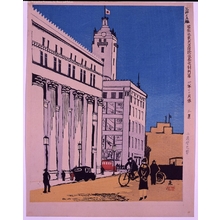
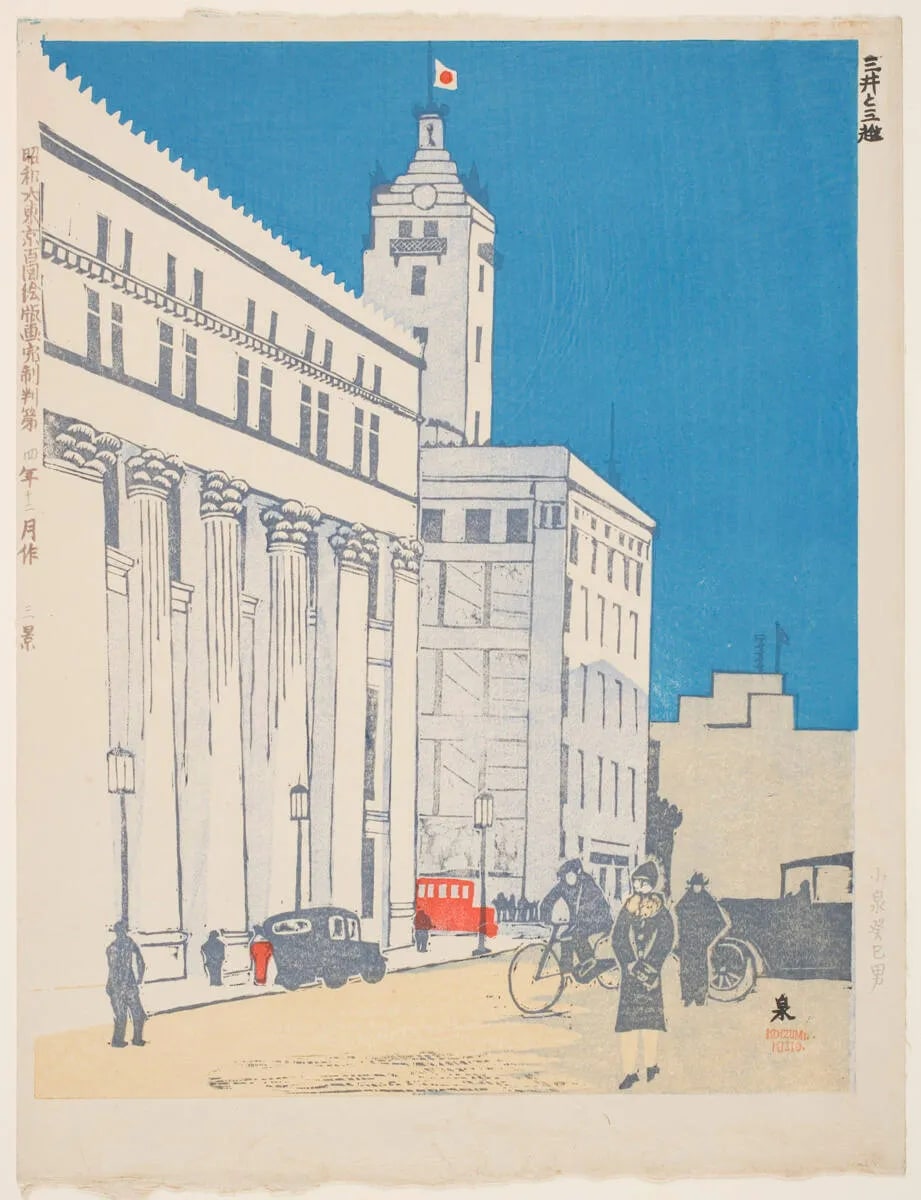
Japanese Print "Mitsui and Mitsukoshi Department Stores (Mitsui to Mitsukoshi)" by Koizumi Kishio
Artist:Koizumi Kishio
Title:Mitsui and Mitsukoshi Department Stores (Mitsui to Mitsukoshi)
Date:December 1929
Details:More information...
Source:Worcester Art Museum
Browse all 3,039 prints...
Description:
The powerful financial-industrial giant Mitsui and the largest department store company in Japan, Mitsukoshi, both trace their origins to the same Edo-period merchant who in 1673 opened the Echigoya dry-goods store in Nihonbashi, the city's old retailing center. This store launched the family fortune. During the Meiji period the Mitsui family expanded into banking and mining. The dry-goods business became independent in 1908 when it built a three-story Western-style store in Nihonbashi, south of the Mitsui Bank. Stocked with high-quality goods, it had regular art exhibitions to help attract an affluent clientele. After it was rebuilt in the aftermath of the 1923 earthquake, customers were allowed to keep their shoes on instead of checking footware at the door in the traditional manner. During the reconstruction an auditorium was added that the retailer rented out for meetings and performances. The department store became a one-stop entertainment and shopping mecca. In 1928 Echigoya changed its name to Mitsukoshi. In this print we see the colonnade of the Mitsui bank, which survived the earthquake but was incorporated into a larger Mitsui complex, and, beyond that, the Mitsukoshi department store. Clearly, city life was being transformed (see pl. 13). The architecture, street lamps, cars, and people of this well-known shopping area look like those found in great American or European cities in the same period.